
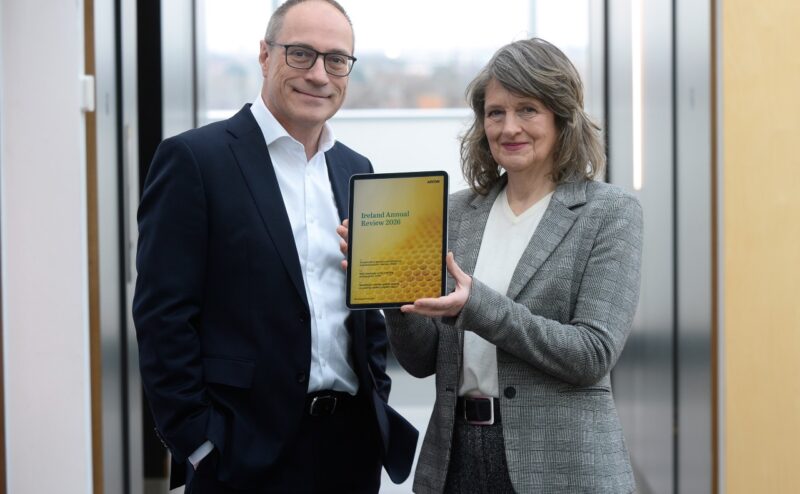
AECOM, the trusted global buildings and infrastructure leader, operating in Ireland for more than 165 years, will launch its 2026 review of the Irish construction industry on Thursday 15 January. In this year’s review of the market and construction costs, AECOM sets out the challenges and opportunities facing the Irish construction and infrastructure sector. It highlights readiness as the essential enabler of Ireland’s ambition to deliver major housing and infrastructure programmes at pace and scale, alongside actions being taken by the Government to remove delivery barriers.
Now in its 51st year, the report also provides a leading benchmark for expected inflation for the construction industry which is forecast at 3 per cent for 2026.
John O’Regan, Director and Country Lead for the Republic of Ireland at AECOM, said: “The Republic of Ireland’s record level of funding for infrastructure projects, alongside a proactive government approach throughout 2025, reflects a clear commitment to strengthening national resilience and accelerating delivery. The Accelerating Infrastructure Action Plan, released in December 2025, sets out a programme of reform aimed at speeding up the provision of infrastructure.
“These measures are in the early stages of implementation; hence the existing deep-rooted constraints continue to slow progress. Delivery agencies are now managing pipelines at an unprecedented scale, within a system that remains well funded on paper but constrained in practice. 2026 must be a year of delivery readiness if the Republic of Ireland is to meet its social and economic goals. Strong public finances provide the foundation, but readiness provides the capability to deliver consistently and confidently.
“The conditions exist to advance essential housing and infrastructure programmes. While capability will take time to build, strengthening readiness internally and across the delivery ecosystem will allow organisations to manage constraints, accelerate timelines and meet Ireland’s urgent delivery needs, making readiness a critical enabler for accelerated delivery.”
Ireland Annual Review 2026
The Ireland Annual Review 2026 covers both the Republic of Ireland and Northern Ireland. It finds that while economic conditions remain generally favourable and record funding is available in the Republic of Ireland, structural and capability constraints continue to limit housing and infrastructure delivery.
In the face of these challenges, the industry’s usual ‘can-do’ attitude and resilience are being tested. ‘Report fatigue’ is growing at every level. Further delays in delivering critical infrastructure risk discouraging international contractors from entering the Irish market – and may prompt more Irish contractors and consultants to follow those who have already sought opportunities abroad.
Key factors influencing development in Ireland in 2026 include:
The report calls for the need to prioritise readiness to secure Ireland’s ability to deliver its ambitious pipeline of major projects, programmes and portfolios at pace. Defined as ‘strategic preparation’, readiness encompasses an organisation’s internal capability, such as having the right skills, systems and governance in place, as well as external factors like selecting appropriate procurement strategies and the provision of pipeline certainty to aid workforce attraction and retention. AECOM argues that achieving readiness will be key to managing constraints, accelerating timelines and delivering the outcomes Ireland urgently requires.
AECOM concludes that with strong public finances, continued private investment and a resilient construction sector, the foundations exist to deliver development projects to support economic growth. The critical task is strengthening readiness internally and across the delivery ecosystem to unlock Ireland’s housing and infrastructure potential as swiftly and proactively as possible.