
McCallion Group is delighted to be a finalist in the highly-competitive ‘Commercial’ category of the upcoming Irish Construction Excellence (ICE) Awards for its successful delivery of Ireland’s first Net Zero Energy supermarket for Lidl Ireland in Maynooth, Co. Kildare.
Lidl Maynooth represents a transformative milestone in sustainable retail construction in Ireland. As one of Lidl’s first fully electrified, operationally Net Zero, and BREEAM-accredited supermarkets, the project showcases a pioneering integration of Modern Methods of Construction (MMC), advanced energy systems and low‑carbon design.
Furthermore, it demonstrates how innovation in construction delivery, material selection, digital coordination, off‑site prefabrication, renewable‑energy integration, airtightness optimisation and supply‑chain upskilling can collectively achieve measurable gains in carbon reduction, building performance, programme certainty and quality. The project adopts the most onerous definition of Net Zero as set out by the Irish Green Building Council and establishes a new standard of sustainable retail in Ireland.
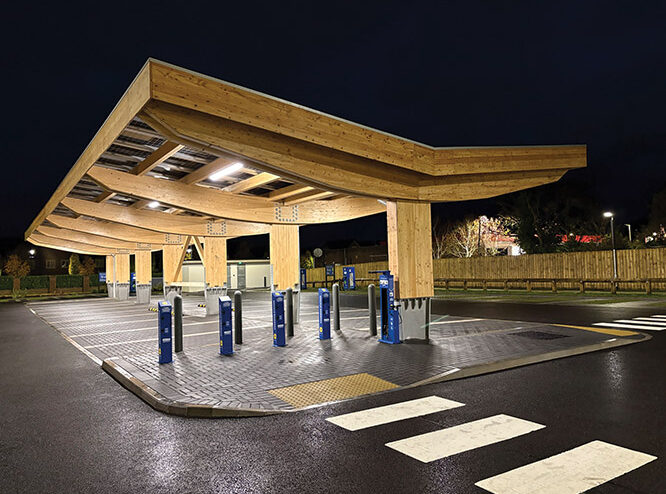
The store generates all of its operational energy from on-site renewable sources and inserts embodied carbon. By significantly reducing energy use and cutting operating costs, Lidl Maynooth prevents 142 tonnes of CO2 emissions annually. It also provides facilities for sustainable commuting, including EV chargers, scooter and bike stations. The integration of a pollinator-friendly community garden, living green wall, green car park spaces and roof planter boxes extend the sustainability mission beyond just energy metrics, contributing to local biodiversity and creating a positive community impact
“We’ve been building and refurbishing stores for Lidl Ireland for the past 20 years and are proud to have delivered this ambitious and groundbreaking project that meaningfully advances industry standards in sustainability, energy efficiency and construction innovation,” McCallion Group commercial manager Edward McKinney enthuses.
“It’s a project that has gained a lot of attention and one that we were very interested in before the tender stage. We’ve been involved with many of Lidl’s other sustainable innovations down the years and this gave us the confidence that we could deliver to BREEAM accreditation requirements. This project underscores our competence in delivering modern developments to the highest standards.”
The Lidl Maynooth project was conceived to replace the existing store with a next-generation supermarket that embodies sustainable retail innovation in Ireland. The primary purpose was to deliver a fully electrified, operational Net Zero supermarket that meets or exceeds emerging ESG standards and BREEAM accreditation requirements. The project also prioritised low-carbon material use, energy efficiency and circular economy principles, while maintaining retail functionality and customer experience.
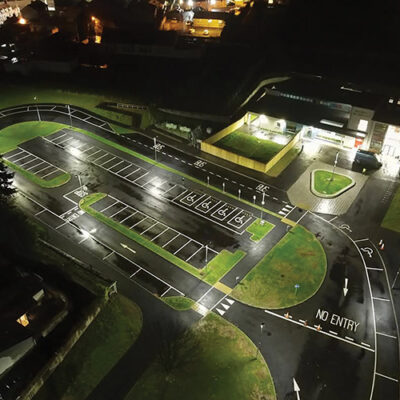
The design integrates a high-quality sales floor, advanced refrigeration and cooling systems, staff facilities, storage, and accessible parking, including EV charging points, e-bike / scooter infrastructure, and waste management solutions. The outcome was a retail environment that delivers long-term operational efficiency, significantly reduced environmental impact and enhanced community amenities.
The scope of works encompassed demolition or partial deconstruction of the existing store, site clearance, construction of new structural and building works, full mechanical, electrical and plumbing installations, integration of renewable-energy systems and extensive sustainability measures. External work included car parking, EV chargers, dedicated e-bike/scooter parking, landscaping and enhanced pedestrian access. The project also included extensive commissioning, handover documentation, and operational training to ensure systems performed optimally from day one.
Construction commenced in February 2025 following temporary closure of the existing store. The procurement strategy adopted an early subcontractor involvement model through a design-build / collaborative procurement route. McCallion Group was appointed as the main contractor, working closely with specialist supply-chain partners for MMC prefabrication, renewable-energy installations, and sustainable material supply.
The Lidl Maynooth project value exceeded €10 million, with the final cost coming in under budget. Key programme drivers included off-site fabrication, lean sequencing and modular delivery of MEP plant systems, which enabled early installation of critical components and minimised on-site construction risks. The approach ensured that construction milestones were achieved efficiently, with minimal disruption to the local community and surrounding infrastructure.
The project created approximately 150 construction jobs during the build phase and 32 permanent positions post-completion, directly benefiting the local economy. The construction programme also engaged in a diverse supply chain, supporting local contractors and specialist sub-contractors in MMC, renewable energy and sustainable materials.
By combining off-site prefabrication, low-carbon materials, energy-efficient MEP systems and renewable energy integration, it significantly reduced both operational and embodied carbon compared with traditional retail construction. Recycled and responsibly sourced materials were maximised, and waste diversion rates exceeded 70% during construction.
The state-of-the-art store features a 556 kWp solar panel system installed on both the roof and within the car park, further cementing Lidl’s position as the owner of the largest rooftop solar array in the country.
The building also incorporates concrete made from 50% recycled materials, sustainable glulam timber roof beams and lower embodied carbon roof panels. Additionally, stone from Lidl’s original Maynooth store was 100% recycled onsite to further reduce emissions and reused as part of the build.
The project adopted a structured and collaborative delivery model built on early contractor involvement, coordinated design development and Lean programme management. McCallion Group were engaged from the early design stage, enabling critical buildability reviews, early procurement of long-lead items, and seamless integration of Net Zero components such as the 556 kWp PV system, 215 kWh battery, specialist façade elements and enhanced commissioning requirements. A detailed master programme was developed and monitored through weekly design coordination meetings and weekly site walkdowns, ensuring continuous alignment between design intent, programme and on-site progress.
BIM and 3D modelling were extensively used to resolve structural, M&E, PV and façade interfaces before works commenced. Off-site fabrication of the precast columns, stairs and slabs accelerated the superstructure programme while improving quality, reducing rework and minimising on-site risk. A modular canteen kitchen installation further streamlined the internal fit-out phase. The delivery was aligned with BREEAM commissioning pathways, including airtightness, thermographic and indoor air-quality testing, ensuring the building met Net Zero performance standards at handover.
Collaboration was central to the successful delivery of this highly-technical project. Weekly multidisciplinary meetings brought together the client, architect, M&E consultants, structural engineers, BREEAM assessor and contractor to coordinate design development, monitor progress and resolve interface issues collaboratively.
Subcontractor collaboration was especially critical due to the complex structural interfaces between Irish-manufactured precast elements and Wiehag’s Austrian-fabricated glulam beams. Joint workshops were held with the architect, contractor, precast supplier and Wiehag to verify tolerances, connection details and sequencing before fabrication, preventing installation risk during assembly.
The unique living wall façade represented another major collaborative element, requiring detailed coordination between the landscapers, façade framing contractor, architect and M&E team. The system includes a fully automated irrigation system with controls located in the plant room, requiring integrated design to ensure waterproofing integrity, correct drainage, structural support and long-term maintainability.
Specialist collaboration also extended to Greenvolt (PV + battery installation), BET (airtightness, thermographic and VOC testing), and ESB Networks (G10 grid protection and grid tie-in).
“The time constraints were very tight due to the need for the client to reopen for business as quickly as possible. This is where our proven ability for completing projects on time really stood to us. We also pride ourselves on our agile workforce and ability to make decisions and take actions quickly,” Edward adds.
“A full-height external living wall façade with automated irrigation – delivering biodiversity uplift, ecological enhancement and visual amenity to the public realm forms – is a really innovative feature in the new building. That type of detail hasn’t been integrated in a commercial project in Ireland before. The plants had to be grown specifically for this project. The irrigation system takes water from the roof, making it fully self-sufficient.
“The whole store operates entirely on on-site renewable energy.”
A Hush Pod battery system was deployed during construction to reduce reliance on diesel generators, particularly for charging tools, welfare units, and temporary site power. This significantly lowered construction-phase carbon emissions, eliminated generator noise, and reduced local air pollution and disturbance to nearby residents. The use of battery-powered temporary energy solutions demonstrated Lidl’s commitment to low-carbon construction practices and aligned with the project’s overall Net Zero philosophy.
The opening of this Net Zero Energy store marks a significant milestone in Lidl’s commitment to achieving net-zero by 2050 across its entire supply chain, as part of its ‘A Better Tomorrow’ sustainability strategy. This means that the retailer will reduce greenhouse gas emissions as close to zero as possible by the middle of the century and offset unavoidable emissions. Lidl has committed to reducing carbon emissions by 46% on operational emissions by 2030.
“We see Lidl Maynooth as a pilot project which gives us an opportunity to see how it performs and how we deliver future Net Zero stores. It’s an expensive, but brilliant concept,” Edward says.
“This project is a benchmark for sustainable commercial construction in Ireland. It successfully balances high-quality retail delivery with Net Zero energy performance, environmental stewardship, and community engagement. By combining innovative construction methodologies, renewable energy systems, and a circular approach to materials, the project not only meets the functional and commercial requirements of Lidl Ireland but also establishes a model for future sustainable retail developments across the country.”
Celebrating 25 years in business, McCallion Group has established itself as a trusted contractor in the delivery of high-quality construction projects nationwide. Operating from Buncrana, Co. Donegal, the company employs a directly managed workforce of 70, enabling a high level of control, consistency and quality across all stages of project delivery.
The Group provides a comprehensive suite of services, including design and build, groundworks and civil engineering through its McCallion Civils division. Its project portfolio spans the public and private sectors, encompassing commercial, retail and residential developments, reflecting both its versatility and depth of technical expertise.
A defining feature of McCallion Group’s operations is its commitment to quality and programme certainty. Projects are closely monitored to ensure delivery within agreed timelines and budgets, while maintaining strict adherence to client specifications and industry standards. This is underpinned by a strong emphasis on workmanship, attention to detail and a proactive, solutions-focused approach.
A strong culture of teamwork, alongside a continued focus on health and safety and operational efficiency, has been central to the company’s sustained growth and reputation for reliability within the industry.
McCallion Group
Unit 20,
Lisfannon Industrial Estate,
Fahan,
Buncrana,
Co. Donegal,
F93 YK19.
Telephone: 074 936 2952
Email: [email protected]
Web: www.calliongroup.ie
This article was published in Building Ireland Magazine, August 2026, Vol 12 No 8