
Pioneering research led by Trinity College Dublin, in partnership with Gannon Eco and McGrath Quarries, is transforming “red mud” industrial by-product into a high-performance, low-carbon construction material. The team is now successfully moving from laboratory development to real-world industrial trials.
Bauxite refining residue, commonly known as red mud, is the principal waste generated from alumina production. Supported by Enterprise Ireland’s Innovation Partnership Programme, the initiative is testing the commercial viability of substituting conventional, high-emission cement with sustainable alternatives.
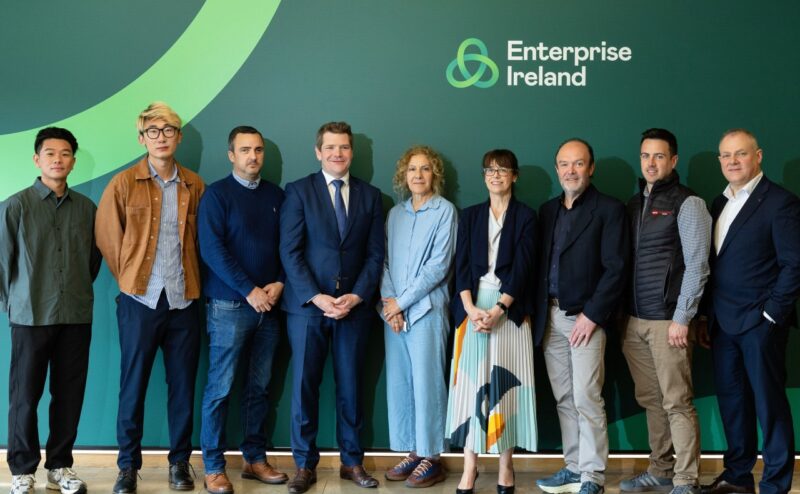
Recognised for its significant potential, the initiative was showcased as a Featured Project at the Enterprise Ireland Construction Materials Forum this summer, and the team recently shared comprehensive findings at an Innovation Partnership Workshop at Trinity.
Led by Professor Sara Pavia, alongside Dr Zehao Lei and doctoral researcher Yingjie Pan from Trinity’s School of Engineering, the team is exploring multiple pathways to integrate bauxite refining residue into structural concrete.
Prof. Sara Pavia, PI and academic lead at Trinity, said: “This project demonstrates that with rigorous science and industry collaboration, we can transform this by-product into a high-performance structural material. We are not just reducing the carbon footprint of concrete; we are actively building a circular economy.”
The first route uses the residue as a Supplementary Cementitious Material (SCM). Laboratory testing has demonstrated that replacing 20-30% of conventional Portland cement with bauxite residue achieves a compressive strength comparable to standard reference concrete.
The second, more transformative route develops a “one-part geopolymer”, which is a dry binder combining the residue with other sustainable ingredients. When mixed with water and aggregates, it acts as a highly effective cement replacement that seamlessly runs through existing batching equipment without the need for additional chemical additives.
While conventional concrete is carbon-intensive, the carbon assessments presented by the Trinity team indicate drastic emissions reductions. The innovative geopolymer formulations can achieve a remarkable 67.8% to 79.8% reduction in carbon footprint compared to standard CEM II-A/L cement across raw material supply, transport and manufacturing.
Crucially, these environmental benefits do not compromise material performance. Under rigorous laboratory conditions testing durability under sulphate exposure, repeated wetting and drying and frost action, the bauxite refining residue-based geopolymer formulations consistently matched or even exceeded conventional concrete. Notably, after 56 freeze-thaw cycles, the bauxite residue geopolymer exhibited a strength retention of 109.7% relative to its 28-day baseline.
“The most exciting aspect of this research is seeing our formulations succeed beyond the laboratory,” explains Dr Zehao Lei, Co-lead of the project.
“Achieving nearly an 80% reduction in carbon emissions while maintaining – and in severe freeze-thaw, wet-dry and sulphate conditions – even exceeding the durability of conventional cement is a major technical milestone for sustainable construction.”
While laboratory results are stellar, the project’s true value lies in its transition to industrial conditions. Using industrial batching equipment alongside Gannon Eco and McGrath Quarries has exposed practical challenges that lab testing alone cannot resolve.
“From a manufacturer’s perspective, any new low-carbon material must be practical for everyday use,” notes Padraic McGrath, Industrial Lead at McGraths Limestone (Cong) Ltd. “What makes this geopolymer so promising is that it can run through our existing batching equipment. By addressing real-world challenges like workability and set times, we are paving the way for this to become an industry standard.”
The team has identified that maintaining concrete workability (slump retention) for transport and placement, as well as managing the cost of geopolymer activators, remain key hurdles for widespread commercialisation. The researchers are now actively refining additive formulations and developing lower-cost, waste-derived activators to address these issues.
“At Gannon Eco, our core mission is finding ‘a new way to think about waste,’” adds John Irwin, Industrial Lead at Gannon Eco. “Partnering with Trinity allows us to take this industrial residue stream and prove its viability on a commercial scale. This is exactly the kind of scalable, sustainable innovation the construction sector urgently needs.”
The road to full commercialisation continues with upcoming phases dedicated to long-term performance validation and regulatory qualification. However, the milestones achieved thus far send a clear message to the global construction sector: transforming ‘red mud’ into a scalable, low-carbon building block is no longer just a theory.